Introduction
On-page SEO is where most websites either earn or lose their rankings. You can have a fast, technically sound website and a healthy backlink profile, but if individual pages aren’t aligned with what searchers want, optimized for how Google reads content, and structured to communicate relevance clearly — they won’t perform.
On-page SEO encompasses everything you control directly on a webpage: the content itself, how it’s structured, how metadata is written, how images are handled, how pages link to one another, and how clearly the page demonstrates experience, expertise, authority, and trust. This guide covers every element, explains the reasoning behind each practice, and gives you a complete checklist to systematically optimize any page — from a new blog post to a critical landing page to a product page on your ecommerce store.
Quick Answer
On-page SEO is the practice of optimizing individual web pages so they rank higher in search results and better serve user intent. It covers content quality and depth, search intent alignment, title tags, meta descriptions, heading structure, URL format, internal linking, image optimization, semantic keyword usage, and E-E-A-T signals. Unlike technical SEO (site infrastructure) and off-page SEO (external authority), on-page SEO focuses on what you publish and how you present it on each individual page.
Key Takeaways
- On-page SEO is about matching what you publish to what searchers want — and communicating that relevance clearly to Google.
- Search intent is the foundation: optimizing for the wrong intent type produces poor results regardless of other optimizations.
- Title tags and H1s are distinct elements — each plays a different role and should be optimized separately.
- Semantic SEO and entity optimization have become as important as keyword placement for modern rankings.
- E-E-A-T signals influence how Google evaluates content quality, especially in competitive or sensitive niches.
- Internal linking is one of the most underused on-page optimization levers available to most websites.
- On-page SEO isn’t a one-time task — content freshness and regular updates actively support sustained rankings.
1. What Is On-Page SEO?
On-page SEO (also called on-site SEO) is the practice of optimizing the content and HTML elements of individual web pages to improve their visibility in search engines and their usefulness to users. It’s one of the three foundational pillars of SEO alongside technical SEO (site infrastructure) and off-page SEO (external signals like backlinks).
On-page SEO includes everything you have direct control over on a page:
- The content itself — depth, accuracy, relevance, and originality
- Structural HTML elements — title tags, headings, metadata, URLs
- Media — images, video, and their optimization
- Internal links — how pages connect to and support each other
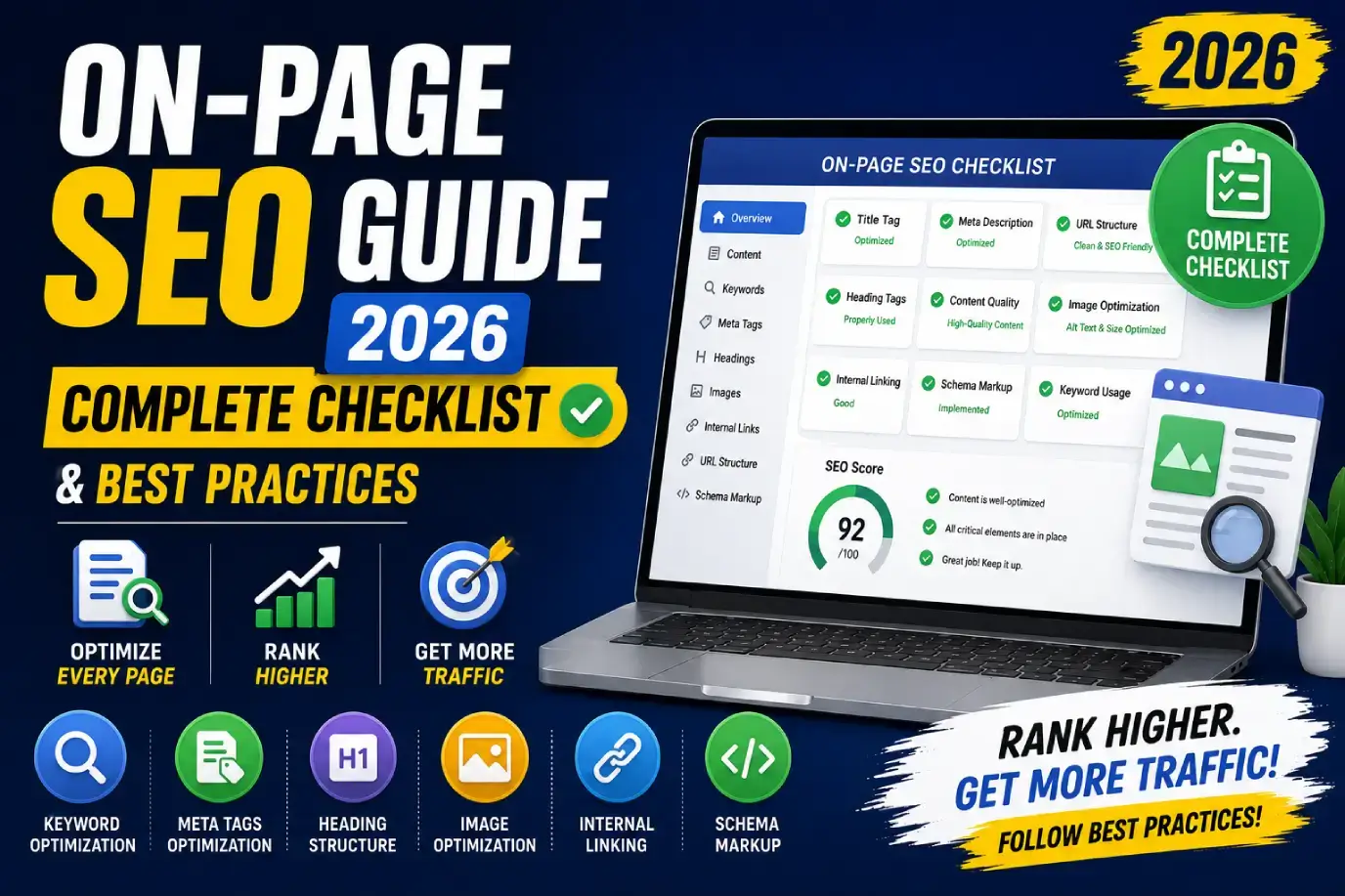
- Semantic signals — entity mentions, NLP keyword coverage, topical completeness
2. Why On-Page SEO Matters
On-page optimization is where you demonstrate to search engines — and to users — that your page deserves to rank for a given query. Without it, even technically sound websites with strong backlink profiles will underperform.
On-page SEO matters because:
- It directly controls how well your content matches what searchers want.
- It determines whether Googlebot can identify the topic, intent, and authority signals on each page.
- Well-optimized pages earn higher click-through rates (CTR) from better titles and meta descriptions.
- Strong content quality and structure reduce bounce rates and improve engagement signals.
- Internal linking from on-page optimization helps Google understand site-wide topical authority.
3. How Google Understands Web Pages
Google evaluates pages through a multi-stage process:
- Crawling — Googlebot downloads the page HTML (and renders JavaScript where needed).
- Parsing — Google reads the structural elements: title, headings, links, and body content.
- Semantic analysis — Google identifies entities, topics, and relationships mentioned on the page, not just keyword matches.
- Intent matching — Google compares the page’s content format and depth to what the search results for that query typically look like.
- Quality evaluation — E-E-A-T signals, content accuracy, and user experience factors influence ranking position.
Modern Google search is fundamentally semantic — it understands meaning and context, not just keyword frequency. On-page SEO that treats optimization as “keyword placement” misses how the system actually works today.
4. Search Intent Optimization
Search intent is the underlying purpose of a search query — why someone is searching, not just what they typed. Matching search intent is the single most important on-page SEO factor because content that doesn’t match intent won’t rank, regardless of how well everything else is optimized.
The four primary intent types:
| Intent Type | What the User Wants | Content Format Match |
|---|---|---|
| Informational | Learn something | Guides, how-tos, definitions, explanations |
| Commercial Investigation | Evaluate options before buying | Comparisons, reviews, “best of” lists |
| Transactional | Make a purchase or take action | Product pages, pricing pages, landing pages |
| Navigational | Reach a specific website or page | Homepage, brand-specific content |
Before optimizing any page, analyze the current top-ranking results for your target keyword. Their content format, length, angle, and depth reflect what Google has determined best satisfies searcher intent for that query.
5. Keyword Research for Individual Pages
Keyword research for individual pages focuses on identifying:
- Primary keyword — the main term the page is optimized for, reflecting the core topic and intent.
- Secondary keywords — closely related terms that should appear naturally throughout the content.
- Semantic and NLP keywords — related entities, concepts, and phrases that signal topical completeness.
- Long-tail variations — more specific queries the page can also rank for with strong primary optimization.
Each page should target one primary keyword (or closely related keyword group) to avoid keyword cannibalization — where multiple pages compete against each other for the same search query, diluting the authority signals for both.
6. Title Tag Optimization
The title tag is the clickable headline shown in search results. It’s one of the strongest on-page relevance signals and the most visible element to users browsing search results.
Best practices:
- Include the primary keyword, positioned naturally toward the beginning where possible.
- Keep length within approximately 50–60 characters to avoid truncation in search results.
- Write for the user first — a title that earns clicks supports rankings; a title no one clicks on loses them.
- Make each title unique across the site; duplicate titles create ambiguity for both users and search engines.
- Don’t keyword-stuff — one natural inclusion is more effective than forced repetition.
Example:
- Weak: “SEO Guide – SEO Tips – SEO Best Practices 2026”
- Strong: “On-Page SEO Guide (2026): Complete Checklist to Optimize Every Page”
7. Meta Description Optimization
The meta description is the short text block shown below the title tag in search results. It’s not a direct ranking factor, but it significantly influences whether users click through — which affects the organic traffic a well-ranking page actually earns.
Best practices:
- Write a compelling, accurate summary of the page’s content and value.
- Include the primary keyword naturally — Google often bolds matching terms in the displayed description.
- Keep length within 150–160 characters to avoid truncation.
- Include a soft call-to-action where appropriate (“Learn how,” “See the full breakdown,” “Start with”).
- Write a unique meta description for every page — don’t leave it to auto-generation, which typically produces weak or truncated descriptions.
Note: Google sometimes overrides meta descriptions with its own summary pulled from page content, particularly when it determines the written description doesn’t well represent the page for a given query.
8. URL Structure
URLs are read by both users and search engines. A clean URL communicates topic and structure at a glance.
Best practices:
- Use lowercase letters and hyphens as word separators.
- Keep URLs short and descriptive — include the primary keyword, exclude filler words.
- Match URL structure to site hierarchy (e.g.,
/blog/on-page-seo-guidefor a blog post under the blog section). - Avoid dynamic parameters, session IDs, or auto-generated IDs in URLs for important pages.
- Once a URL is live and indexed, avoid changing it without implementing a 301 redirect — broken URLs lose accumulated ranking signals.
9. Heading Hierarchy (H1–H6)
Headings provide structural clarity for users and help search engines identify the page’s topic hierarchy.
| Heading | Role | Best Practice |
|---|---|---|
| H1 | Page title — the main topic of the entire page | One per page; include the primary keyword; match or closely complement the title tag |
| H2 | Major section headers | Describe the main sections; include secondary and semantic keywords naturally |
| H3 | Subsections within H2 sections | Add specificity; useful for how-to steps, examples, and sub-topics |
| H4–H6 | Nested sub-sections | Use when genuinely needed for structure; rarely required for most content |
The H1 and the title tag serve different functions — the title tag is the search result headline; the H1 is the page’s on-page headline. They can be identical or slightly different, but both should include the primary keyword.
10. Writing High-Quality SEO Content
Content quality is the core of on-page SEO. Search engines have become increasingly capable of distinguishing genuinely useful, well-researched content from thin, AI-generated, or keyword-stuffed filler.
Quality content characteristics:
- Directly answers the query — lead with the most important answer before elaborating.
- Appropriate depth — cover the topic thoroughly enough to fully satisfy the searcher, but don’t pad with irrelevant information to hit a word count.
- Accurate and verifiable — avoid unsupported claims; cite authoritative sources where relevant.
- Original perspective — adds value beyond what’s already available in top-ranking results.
- Readable — short paragraphs, active voice, logical flow, and formatting that’s scannable on both desktop and mobile.
- Structured for how people read online — the majority of users scan before committing to deep reading; headers, bullet points, and tables aid comprehension.
The key benchmark: would a subject-matter expert find this page genuinely useful, accurate, and worth sharing?
11. Semantic SEO & Entity Optimization
Modern Google search understands topics through entities and their relationships — not just keyword frequency. Semantic SEO is the practice of building content that covers a topic comprehensively and uses the natural vocabulary associated with that topic.
Entity optimization means mentioning the specific people, places, products, concepts, and organizations that Google’s Knowledge Graph associates with the topic you’re covering. A page about “on-page SEO” that doesn’t mention title tags, meta descriptions, search intent, or E-E-A-T is signaling incompleteness, regardless of keyword placement.
Practical semantic SEO steps:
- Identify entities and related concepts associated with your topic (tools like Semrush, Clearscope, or Surfer SEO analyze competitor content for semantic coverage).
- Write naturally using the vocabulary of the subject — don’t force keywords; let topic coverage drive relevance.
- Use heading structures that reflect the natural sub-topics of the subject.
- Build content clusters — groups of related pages that together demonstrate deep topical authority, linking back to a central pillar page.
12. Internal Linking Strategy
Internal links are links between pages on your own website. They’re one of the most underused on-page optimization tools available to most websites, despite being entirely within your control.
Internal links serve three key SEO functions:
- Crawlability — they help Googlebot discover pages it might otherwise miss.
- Authority distribution — links pass relevance and equity signals between pages.
- Topical context — descriptive anchor text from one page to another signals to Google what the linked page is about.
Best practices:
- Use descriptive, keyword-relevant anchor text (not “click here” or “read more”).
- Link from high-traffic or high-authority pages to pages you want to rank.
- Ensure every important page receives at least one contextual internal link.
- Audit for orphan pages (pages with no internal links pointing to them) — they receive no crawl or relevance signals.
- Avoid over-linking — too many links on a single page dilutes the signal value of each.
13. External Links Best Practices
External links (links from your page to other websites) are a trust and relevance signal, not a liability — when used correctly.
Best practices:
- Link to authoritative, relevant external sources (official documentation, research, government sites) where they add genuine value.
- Use
rel="nofollow"for sponsored or paid links, andrel="ugc"for user-generated content, per Google’s link attribute guidelines. - Don’t link to low-quality, spammy, or irrelevant sites.
- External links don’t “leak” significant equity in ways that hurt your rankings when used naturally.
14. Image SEO
Images are often the most under-optimized element on most web pages.
Image SEO best practices:
- File names: Use descriptive, hyphenated file names before uploading (e.g.,
on-page-seo-checklist.jpg, notIMG_1234.jpg). - Alt text: Write accurate, descriptive alt text that describes the image content — it’s read by search engines and screen readers.
- File size: Compress images to minimize file size without visible quality loss; use modern formats (WebP, AVIF) where supported.
- Dimensions: Specify explicit width and height attributes to prevent Cumulative Layout Shift (CLS).
- Lazy loading: Implement for below-the-fold images to improve initial page load time.
- Image sitemaps: For image-heavy content, an image sitemap helps Google discover and index images.
15. Multimedia Optimization
Beyond images, video and other multimedia elements can be optimized:
- Host video on YouTube or a dedicated video CDN rather than serving directly from your server to avoid performance impact.
- Provide transcripts for video content — transcripts make spoken content indexable by search engines.
- Add schema markup for VideoObject to enable rich results in search.
- Ensure all multimedia has appropriate accessibility attributes (captions, transcripts, aria labels).
16. Featured Snippet Optimization
Featured snippets are the boxed answers shown above regular results for many queries — often called “position zero.” Appearing in a featured snippet dramatically increases visibility and often click-through rate for informational queries.
Featured snippets come in several formats:
| Snippet Type | Best Content Format | Example Trigger |
|---|---|---|
| Paragraph | 40–60 word direct answer following a question heading | “What is X?” |
| Numbered list | Step-by-step structured sections | “How to do X” |
| Bulleted list | Collections of items or features | “Best practices for X” |
| Table | Comparison or structured data | “X vs Y” or “Types of X” |
To target featured snippets:
- Structure your content around the exact phrasing of the target query in a heading.
- Provide a concise, direct answer immediately below the relevant heading.
- Use appropriate content formats — lists for “how to” and “best of” queries, paragraphs for definitions.
17. AI Overview & GEO Optimization
Google AI Overviews generate AI-synthesized answers directly in search results, typically drawing from multiple sources. Appearing in AI Overviews requires content that AI systems can parse, trust, and confidently cite.
GEO (Generative Engine Optimization) best practices for on-page content:
- Provide clear, concise, directly stated answers at the top of sections — AI systems favor extractable, self-contained answers.
- Use structured formatting (headings, lists, tables) that AI parsing can interpret reliably.
- Demonstrate E-E-A-T clearly — AI systems prioritize sources that demonstrate clear expertise and authority.
- Keep factual claims accurate and verifiable — AI Overviews risk surfacing inaccurate information and Google prioritizes pages that reduce that risk.
- Include FAQ sections with concise answers — these are highly extractable by both featured snippet and AI Overview systems.
- Entity clarity matters: name and define the entities your content covers so AI systems can correctly attribute topic relevance.
18. E-E-A-T for On-Page SEO
E-E-A-T (Experience, Expertise, Authoritativeness, Trustworthiness) is the quality framework Google’s Search Quality Rater Guidelines use to evaluate content. It’s not a direct ranking algorithm, but it describes the characteristics of content that Google’s systems are designed to reward.
How to demonstrate E-E-A-T on individual pages:
| Signal | On-Page Implementation |
|---|---|
| Experience | First-hand examples, case studies, original data, real-world application |
| Expertise | Technically accurate, well-sourced content from a clearly qualified author or organization |
| Authoritativeness | Author bio with credentials, references to recognized sources, coverage that signals subject mastery |
| Trustworthiness | Accurate claims, clear citations, transparent authorship, updated publication dates |
E-E-A-T signals matter most for YMYL (Your Money or Your Life) topics — health, finance, legal, safety — but increasingly influence quality evaluation across all niches.
19. Content Freshness & Updates
Search engines favor current, accurate content — particularly for time-sensitive or fast-evolving topics. Content decay (rankings dropping as content becomes outdated) is one of the most common causes of organic traffic loss for established sites.
Content freshness best practices:
- Audit underperforming pages for outdated information, statistics, or broken examples.
- Update the publication or last-reviewed date when content is substantively revised — not just for a cosmetic update.
- Add a “last updated” indicator for guides and reference articles to signal currency to both users and search engines.
- Prioritize refresh cycles for pages covering rapidly changing topics (platform pricing, algorithm updates, regulatory guidance).
- When updating, focus on substantive improvements — adding new information, revising outdated claims, expanding thin sections — not just minor rewrites.
20. On-Page SEO Audit Checklist
Search Intent & Content
- Page content format and depth matches the dominant search intent for the target keyword
- Primary keyword identified — no keyword cannibalization with other site pages
- Content provides a complete, accurate, and original answer to the query
- Content demonstrates E-E-A-T signals appropriate to the topic
HTML Elements
- Title tag includes primary keyword, is unique, and under 60 characters
- Meta description is unique, compelling, and under 160 characters
- URL is short, descriptive, uses hyphens, and includes the primary keyword
- One H1 per page, includes primary keyword
- H2s and H3s use secondary/semantic keywords naturally
- Heading hierarchy is logical and consistent
Content Quality
- Semantic and NLP keywords integrated naturally throughout content
- Entities relevant to the topic are mentioned
- No keyword stuffing
- Content is readable: short paragraphs, active voice, scannable structure
- Tables, lists, and structured formats used where appropriate
Internal & External Links
- Key pages receive internal links with descriptive anchor text
- No orphan pages among priority content
- External links point to authoritative, relevant sources
- No broken internal or external links on the page
Image & Media
- All images have descriptive alt text
- Image file names are descriptive (not IMG_001.jpg)
- Images compressed and using modern format (WebP/AVIF)
- Width and height attributes specified on images
Featured Snippets & AI Readiness
- Concise, direct answers placed immediately after relevant question headings
- FAQ section present with concise answers
- Structured data (schema) implemented where relevant
Freshness
- Content is current and accurate
- Last-updated date reflects actual revision date
21. Common On-Page SEO Mistakes
- Writing for keyword density rather than topic completeness
- Using the same or very similar title tags across multiple pages
- Targeting broad, high-competition keywords without considering search intent
- Duplicate content — publishing the same or very similar content at multiple URLs
- Ignoring internal linking, particularly failing to link to new or underperforming pages
- Using generic alt text (“image1.jpg,” “photo”) or leaving alt text empty for informational images
- Optimizing old content with cosmetic updates only, rather than substantive revisions
- Creating keyword cannibalization by publishing multiple thin pages on the same topic
- Forgetting to update the meta description when significantly revising page content
22. Tools & Resources
- Google Search Console — monitor page performance, indexing status, CTR, and query data
- Google Search Quality Rater Guidelines — the official framework describing E-E-A-T and content quality
- Google Trends — understand query seasonality and rising topics
- Schema.org — structured data vocabulary for implementing rich result markup
- web.dev — Google’s performance and web standards guidance
- MDN Web Docs — technical reference for HTML elements (title, meta, heading tags)
- W3C — web standards and accessibility (WCAG) reference
- Ahrefs / Semrush / Moz — keyword research, competitor analysis, content gap identification
- Surfer SEO / Clearscope — semantic keyword and NLP content analysis tools
23. Expert Tips
- Analyze the top 3–5 ranking pages for your target keyword before writing — their format, depth, and sub-topic coverage reflect what Google has determined best satisfies that intent.
- Treat your H1 and title tag as distinct elements: the title tag sells the click; the H1 establishes what the page is about to the reader who’s already clicked.
- The best internal linking targets are high-traffic pages that don’t yet link to the page you want to rank — a single strong internal link from a high-traffic page can move rankings noticeably.
- Content freshness audits are often more impactful per hour of effort than creating new pages — updating a page with declining rankings is frequently faster than building new authority from scratch.
24. Real Examples
Blog post optimization: A “how to” guide ranking on page 2 for its target keyword, with title tag updated to include the primary keyword toward the beginning and meta description rewritten with a clear value hook, moved to a featured position on page 1 following those changes alongside content restructuring to provide a direct answer in the opening paragraph.
Product page: An ecommerce product page with generic alt text (“product_photo_1.jpg”) and no descriptive content beyond the product title was reoptimized with proper alt text, a 150-word product description targeting the primary and secondary keywords, and internal links from the category page — improving both organic visibility and on-page conversion.
Content refresh: A pillar guide that had ranked well for 18 months but was losing position due to outdated statistics and missing coverage of newer developments was systematically updated — new sections added, stale data replaced, and outdated screenshots removed — recovering and surpassing its previous ranking.
FAQs
1. What is On-Page SEO?
On-page SEO is the practice of optimizing individual web pages — their content, HTML elements, structure, and internal links — so they rank higher in search results and better serve user intent.
2. Why is On-Page SEO important?
On-page SEO determines how well each page communicates its relevance to search engines and how well it satisfies what searchers are looking for — without it, even technically sound sites with strong backlinks underperform.
3. How do I optimize a webpage for SEO?
Start by identifying the primary keyword and understanding its search intent, then optimize the title tag, URL, H1, content depth, internal links, image alt text, and meta description — all to clearly signal relevance and provide genuine value to searchers.
4. What are On-Page SEO ranking factors?
Core on-page ranking factors include search intent alignment, content quality and depth, title tag, H1, URL structure, semantic keyword coverage, internal linking, page experience (speed, mobile usability), and E-E-A-T signals.
5. How many keywords should a page target?
Each page should have one primary keyword (or closely related keyword group) and naturally incorporate secondary and semantic keywords — targeting too many unrelated primary keywords on a single page creates focus dilution and potential cannibalization.
6. What is search intent and why does it matter?
Search intent is the underlying reason behind a query — whether the user wants to learn, compare, buy, or navigate. Matching the wrong intent type with your content is one of the most common reasons pages fail to rank despite strong technical and link signals.
7. What is the difference between on-page SEO and technical SEO?
On-page SEO optimizes what’s published on individual pages (content, headings, links, metadata); technical SEO optimizes the site’s infrastructure so search engines can efficiently crawl, render, and index those pages.
8. How do title tags affect SEO?
Title tags are one of the strongest on-page relevance signals — they tell both users and search engines what the page is about, and they’re the headline shown in search results, directly influencing whether users click.
9. How important are internal links for on-page SEO?
Internal links are highly impactful and frequently underused — they distribute crawl signals and authority across the site and signal topical relevance between connected pages through their anchor text.
10. What is E-E-A-T and how do I demonstrate it?
E-E-A-T (Experience, Expertise, Authoritativeness, Trustworthiness) is Google’s quality evaluation framework — demonstrated through accurate content, clear author credentials, real-world examples, verifiable citations, and transparent authorship.
11. How do I optimize for featured snippets?
Structure relevant sections around the exact phrasing of the query in a heading, immediately followed by a concise 40–60 word direct answer, in the format that matches the query type (paragraph, list, or table).
12. What is semantic SEO?
Semantic SEO is the practice of building content that covers a topic comprehensively using the full vocabulary and entity set associated with it, rather than focusing narrowly on keyword frequency — aligning with how modern search engines understand meaning.
13. How often should I update existing content?
Review and refresh content whenever it shows declining rankings or traffic, whenever significant new information becomes available, or on a scheduled cycle (quarterly or annually) for high-value pages covering fast-evolving topics.
14. What is keyword cannibalization and how do I fix it?
Keyword cannibalization occurs when multiple pages on your site compete for the same search query, diluting authority signals for both. Fixes include consolidating thin pages into one comprehensive page, canonicalizing duplicate content, or clearly differentiating each page’s target keyword and intent.
15. Can I do on-page SEO myself?
Yes — most on-page SEO tasks are manageable without advanced technical knowledge, using tools like Google Search Console and Semrush. Competitive niches or larger sites often benefit from professional SEO expertise for audit depth and ongoing strategy.
Conclusion
On-page SEO is the discipline of ensuring every page on your website clearly communicates its relevance, authority, and value — to both the people visiting it and the search engines deciding whether to show it. It spans content quality and depth, structural HTML elements, semantic keyword coverage, internal linking, image optimization, and the E-E-A-T signals that influence how Google evaluates trust and expertise.
The most effective on-page SEO starts with search intent and works outward from there: write for what the searcher actually needs, structure it so search engines can parse it clearly, link pages together to signal topical authority, and revisit content regularly to keep it current. Done consistently, those practices compound into durable, defensible organic visibility.