
Introduction
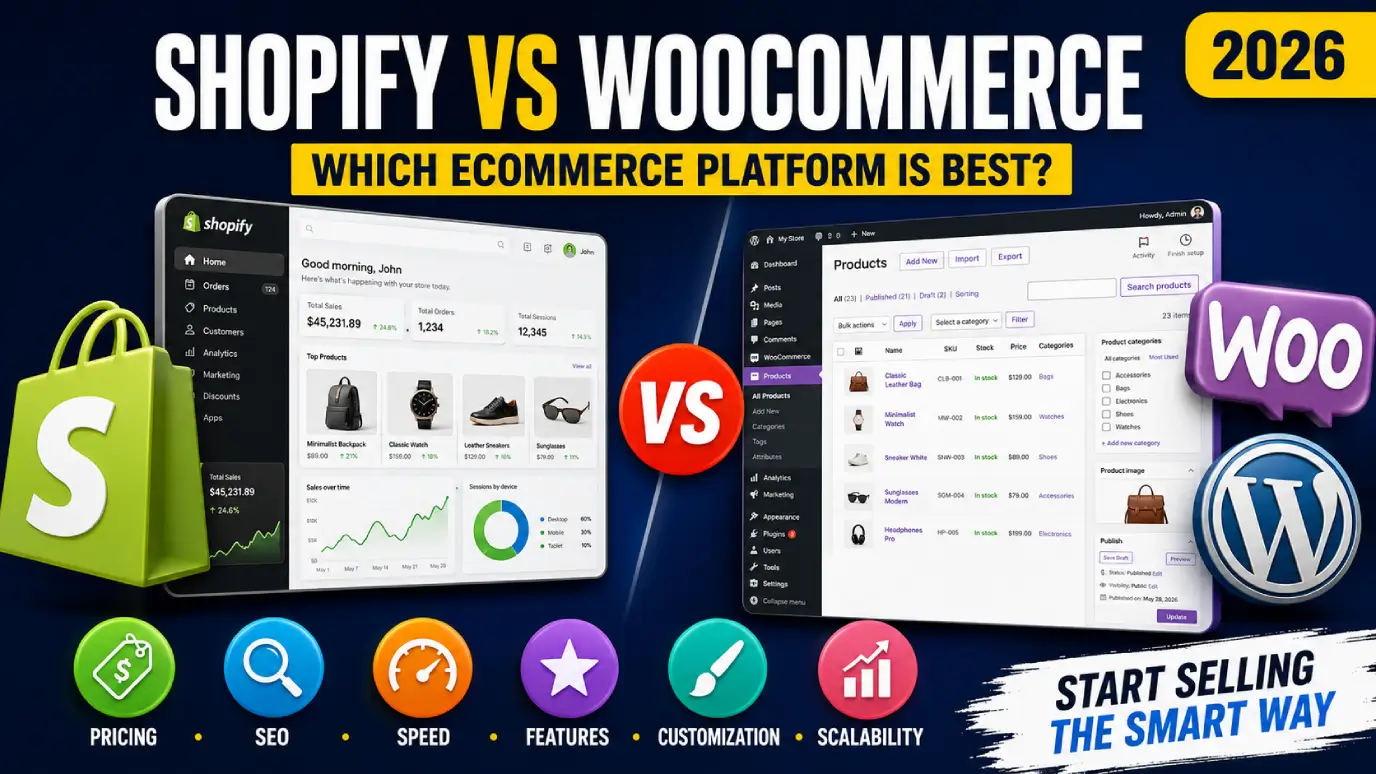
Shopify and WooCommerce power a huge share of online stores worldwide, but they take fundamentally different approaches to ecommerce. Shopify is a fully hosted SaaS platform built for speed and simplicity. WooCommerce is an open-source plugin built on WordPress, offering more flexibility at the cost of more hands-on management.
Choosing between them isn’t about which platform is “better” in absolute terms — it’s about which one fits your technical comfort level, budget, catalog complexity, and growth plans. This guide breaks down every major decision factor: pricing, ease of use, customization, SEO, performance, security, scalability, and total cost of ownership, so you can make a confident, informed choice.
Quick Answer
Shopify is a fully hosted, all-in-one ecommerce platform best suited for businesses that want a fast, low-maintenance setup with predictable monthly costs. WooCommerce is a free, open-source plugin for WordPress best suited for businesses that already use WordPress or want maximum customization and control over hosting, design, and data. Shopify generally wins on ease of use and built-in features; WooCommerce generally wins on flexibility and lower platform fees, though both involve real ongoing costs once apps, plugins, and hosting are factored in.
Key Takeaways
- Shopify is SaaS (hosted, managed); WooCommerce is open-source (self-hosted, self-managed).
- Shopify has predictable monthly pricing plus transaction fees; WooCommerce is “free” but requires paid hosting, plugins, and often more developer time.
- Both platforms can rank well in SEO when properly optimized — neither has an inherent SEO advantage out of the box.
- WooCommerce offers more design and functional flexibility; Shopify offers more built-in reliability and security out of the box.
- Total cost of ownership often evens out over 3–5 years once all costs are accounted for.
- The right choice depends on technical comfort, catalog complexity, and how much control you want over hosting and customization.
1. Shopify vs WooCommerce: Quick Overview
Shopify is a hosted SaaS ecommerce platform — Shopify manages hosting, security, and core infrastructure, and you build your store within their ecosystem using themes and apps.
WooCommerce is a free, open-source plugin that turns a WordPress website into a fully functional online store. You’re responsible for your own hosting, security, and updates, but in exchange you get far more control over how the store is built and customized.
2. Key Differences at a Glance
| Factor | Shopify | WooCommerce |
|---|---|---|
| Platform type | Hosted SaaS | Self-hosted, open-source |
| Starting cost | Monthly subscription | Free core plugin + hosting costs |
| Ease of use | Very beginner-friendly | Moderate learning curve |
| Customization | Moderate (via apps/Liquid) | High (full code access) |
| Hosting | Included | Required separately |
| Maintenance | Managed by Shopify | Managed by you or your developer |
| SEO control | Good, some limitations | Full control |
| Best for | Fast launch, low maintenance | Flexibility, existing WordPress sites |
3. Ease of Use
Shopify is widely regarded as the easier platform to learn, with a guided setup process, intuitive dashboard, and no need to manage hosting or security separately. Most users can launch a basic store within days.
WooCommerce requires more upfront setup — installing WordPress, configuring hosting, and installing the plugin — and a steeper learning curve for non-technical users. However, anyone already comfortable with WordPress will find the transition relatively smooth.
Verdict: Shopify is easier for true beginners; WooCommerce is comparable for those already familiar with WordPress.
4. Pricing Comparison
| Plan Type | Shopify | WooCommerce |
|---|---|---|
| Entry-level | Monthly subscription (~$25–$40/mo for basic plans) | Free plugin + hosting (~$10–$30/mo) |
| Mid-tier | Higher-tier monthly plans with added features | Premium plugins/themes as needed |
| Transaction fees | Apply unless using Shopify Payments | None inherently, but payment processor fees still apply |
| Enterprise | Shopify Plus (custom pricing) | Scales via hosting and custom development |
Shopify’s pricing is more predictable and bundled; WooCommerce’s pricing is more variable and depends heavily on hosting quality, plugin choices, and development needs.
5. Hidden Costs
Both platforms have costs beyond the advertised starting price:
Shopify hidden costs:
- Apps for extended functionality (many charge monthly fees)
- Transaction fees if not using Shopify Payments
- Premium themes
- Custom development for advanced needs
WooCommerce hidden costs:
- Quality hosting (especially as traffic grows)
- Premium plugins for key features (SEO, security, backups)
- Developer time for custom functionality and maintenance
- SSL certificates (often included with good hosting, but not always)
6. Themes & Design
Shopify offers a curated theme marketplace with strong default design quality, plus the Liquid templating language for customization, or full custom development using frameworks like React via Shopify’s Hydrogen.
WooCommerce benefits from the entire WordPress theme ecosystem, offering enormous variety, though quality and ecommerce-readiness vary significantly between themes.
Verdict: Shopify offers more consistent design quality out of the box; WooCommerce offers broader variety with more variance in quality.
7. Customization Options
WooCommerce generally wins on raw customization potential — full access to the underlying code, unlimited plugin combinations, and complete control over hosting and architecture.
Shopify offers solid customization through its app ecosystem and Liquid/theme code access, but some deeper structural changes can be more constrained within its hosted environment, particularly on lower-tier plans.
8. Apps vs Plugins
| Aspect | Shopify Apps | WooCommerce Plugins |
|---|---|---|
| Marketplace | Shopify App Store | WordPress Plugin Directory + premium marketplaces |
| Quality control | Reviewed by Shopify | Variable, less centralized review |
| Cost structure | Often subscription-based | Mix of free and one-time/annual licenses |
| Compatibility risk | Lower (managed environment) | Higher (potential plugin conflicts) |
WooCommerce’s plugin ecosystem is larger and often cheaper per feature, but carries more risk of conflicts since plugins aren’t centrally managed the way Shopify apps are.
9. Ecommerce Features
Both platforms support the core features most stores need: product variants, inventory management, discount codes, customer accounts, and order management. Shopify includes more of these natively out of the box; WooCommerce often requires additional plugins to match the same feature set, which adds cost and complexity but also lets you build exactly what you need without paying for unused features.
10. Payment Gateways
Shopify offers Shopify Payments (built-in, no extra transaction fee) along with support for many third-party gateways like PayPal and Stripe, though non-Shopify Payments options typically incur additional transaction fees.
WooCommerce supports Stripe, PayPal, and numerous other gateways natively without platform-level transaction fees, since WooCommerce itself doesn’t process payments directly.
Verdict: WooCommerce has a slight edge on payment flexibility without added platform fees; Shopify offers a smoother all-in-one setup if using Shopify Payments.
11. SEO Comparison
Neither platform has an inherent SEO advantage — both can rank well when properly optimized, and both have historically had specific limitations to be aware of.
Shopify SEO considerations:
- URL structure for certain page types (like collections) has less flexibility than WooCommerce
- Strong default site speed and security, which support SEO indirectly
- Good native support for metadata, sitemaps, and basic schema
WooCommerce SEO considerations:
- Full control over URL structure and technical SEO elements
- Requires more manual setup or SEO plugins (like Yoast) to reach full potential
- SEO performance depends heavily on hosting quality and theme efficiency
Verdict: Both are SEO-capable platforms; WooCommerce offers more granular control, while Shopify offers stronger defaults requiring less manual configuration. See our ecommerce SEO guide for platform-agnostic best practices.
12. Performance & Speed
Shopify benefits from a managed, optimized hosting infrastructure with built-in CDN delivery, generally resulting in consistent performance without additional configuration.
WooCommerce performance depends heavily on hosting quality, theme efficiency, and plugin load — a well-optimized WooCommerce store on quality hosting can match or exceed Shopify’s speed, but a poorly configured one can be significantly slower.
Verdict: Shopify offers more consistent performance by default; WooCommerce can perform equally well but requires more deliberate optimization effort.
13. Security
Shopify manages security at the platform level, including PCI DSS compliance, SSL, and infrastructure security — largely hands-off for store owners.
WooCommerce requires store owners (or their developers) to manage security actively: keeping WordPress core, themes, and plugins updated, securing hosting, and maintaining PCI DSS compliance through a compliant payment gateway.
Verdict: Shopify offers stronger security by default with less effort; WooCommerce can be equally secure but requires ongoing diligence.
14. Scalability
Shopify scales smoothly for most growing stores, with Shopify Plus available for high-volume enterprise needs, though very large or highly customized catalogs may eventually hit platform constraints.
WooCommerce can scale extensively given the right hosting and architecture, but scaling well typically requires more proactive technical investment as traffic and catalog size grow.
Verdict: Both scale well; Shopify’s scaling path is more turnkey, while WooCommerce’s requires more hands-on technical planning.
15. Customer Support
Shopify provides direct platform support (chat, email, phone depending on plan) since it’s a managed service.
WooCommerce has no centralized support line for the platform itself — support comes from your hosting provider, plugin developers, and the broader WordPress community, or a hired developer/agency.
Verdict: Shopify offers more direct, centralized support; WooCommerce requires assembling your own support resources.
16. Marketing Features
Both platforms support core marketing needs — discount codes, abandoned cart recovery, email integrations, and analytics connections (Google Analytics, Google Merchant Center, Google Ads).
Shopify includes more marketing tools natively or via tightly integrated apps. WooCommerce typically relies on a broader mix of WordPress and third-party marketing plugins, offering more flexibility in tool selection.
17. Blogging Capabilities
WooCommerce, built on WordPress, has a clear advantage here — WordPress is widely regarded as one of the strongest content management and blogging platforms available, making it well-suited for stores investing heavily in content marketing.
Shopify includes basic blogging functionality, sufficient for many stores, but generally less robust than native WordPress for advanced content strategies.
18. International Selling
Both platforms support multi-currency and multi-language selling, though implementation differs:
- Shopify offers built-in multi-currency support (Shopify Payments) and a strong app ecosystem for translation and localization.
- WooCommerce relies on plugins for multi-currency and multi-language functionality, offering flexibility but requiring more setup.
19. Headless Commerce Support
Shopify offers strong headless commerce support through Hydrogen (its React-based framework) and robust Storefront APIs, making it a popular choice for headless implementations.
WooCommerce supports headless setups via its REST API, though headless WooCommerce implementations are generally less standardized and require more custom development work.
Verdict: Shopify currently offers a more mature, purpose-built headless commerce path.
20. AI Features
Both platforms are rapidly expanding AI capabilities:
- Shopify has integrated native AI tools for product descriptions, customer support, and merchandising directly into its platform.
- WooCommerce relies on third-party plugins and integrations for AI features, offering flexibility in tool choice but less out-of-the-box consistency.
As AI-assisted ecommerce and Generative Engine Optimization (GEO) become more important, both platforms are evolving quickly — it’s worth checking current documentation for the latest capabilities.
21. Pros & Cons
| Platform | Pros | Cons |
|---|---|---|
| Shopify | Easy setup, managed hosting/security, consistent performance, strong support | Monthly fees, app costs add up, less raw flexibility |
| WooCommerce | Full control, no core licensing fee, deep WordPress integration, strong content tools | Requires hosting/security management, steeper technical learning curve |
22. Which Platform Is Best for Different Business Types?
| Business Type | Recommended Platform | Why |
|---|---|---|
| First-time store owner, wants simplicity | Shopify | Fast setup, managed infrastructure |
| Existing WordPress/content-heavy site | WooCommerce | Seamless integration, strong content tools |
| Budget-conscious small business | WooCommerce | Lower core platform costs |
| Fast-scaling D2C brand | Shopify | Reliable scaling, strong app ecosystem |
| Highly custom or complex catalog | WooCommerce or headless | Maximum flexibility |
| Enterprise with high traffic | Shopify Plus or custom/headless | Managed scalability or full control |
23. Decision Matrix
Ask yourself these questions to guide your decision:
- Do you want to manage hosting and security yourself, or have it handled for you? → Self-manage: WooCommerce. Hands-off: Shopify.
- Is content marketing/blogging central to your strategy? → WooCommerce has the edge.
- Do you need maximum design and functional flexibility? → WooCommerce.
- Do you want the fastest path to launch with minimal technical overhead? → Shopify.
- Are you planning a headless commerce architecture? → Shopify (Hydrogen) currently has a more mature path.
24. Tools & Resources
- Shopify Help Center — official Shopify documentation
- WooCommerce Documentation and WordPress Developer Resources — official WooCommerce/WordPress guidance
- Google Search Central and Google Merchant Center Help — SEO and shopping feed guidance
- web.dev — performance and Core Web Vitals auditing
- MDN Web Docs — technical web standards reference
- PCI Security Standards Council — payment security compliance standards
25. Expert Tips
- Don’t choose based on price alone — factor in the realistic cost of apps, plugins, and developer time over 3–5 years, not just the advertised starting price.
- If you’re already running a content-heavy WordPress site, WooCommerce often makes more sense than migrating to a separate platform.
- If speed-to-launch and low technical overhead matter most, Shopify’s managed environment removes a significant amount of operational burden.
- Whichever platform you choose, invest in proper SEO and performance optimization from the start — platform choice alone won’t guarantee rankings or speed.
26. Real Examples
D2C apparel brand: A fast-growing apparel brand prioritizing quick launch and minimal technical overhead chose Shopify, valuing its managed hosting and predictable monthly costs as the business scaled.
Content-driven niche retailer: A retailer built around in-depth buying guides and blog content chose WooCommerce to keep content and commerce tightly integrated within a single WordPress ecosystem.
B2B wholesale distributor: A distributor needing complex, custom pricing logic and tight ERP integration chose WooCommerce for its flexibility, accepting the additional development investment required.
FAQs
1. Which is better, Shopify or WooCommerce?
Neither platform is universally “better” — Shopify suits businesses wanting a fast, managed setup, while WooCommerce suits businesses wanting maximum flexibility and control, especially if already using WordPress.
2. Is Shopify easier to use than WooCommerce?
Yes, generally — Shopify’s guided setup and managed hosting make it easier for true beginners, while WooCommerce has a steeper learning curve unless you’re already familiar with WordPress.
3. Is WooCommerce really free?
The WooCommerce plugin itself is free, but running a store still requires paid hosting, and often premium plugins or themes, meaning total costs are not zero.
4. Which platform has better SEO?
Both platforms can achieve strong SEO results when properly optimized — WooCommerce offers more granular technical control, while Shopify offers stronger SEO-friendly defaults requiring less manual setup.
5. Which platform is faster?
Shopify offers more consistent performance by default through managed hosting, while WooCommerce can match or exceed that speed with quality hosting and proper optimization, but requires more deliberate effort.
6. Which platform is more secure?
Shopify manages security at the platform level with less effort required from store owners, while WooCommerce requires active management of updates, hosting security, and compliance.
7. Can I migrate from WooCommerce to Shopify (or vice versa)?
Yes, migration is possible in both directions, typically involving product data, customer data, and order history transfer, along with careful redirect planning to preserve SEO rankings.
8. Which platform is best for small businesses?
It depends on technical comfort and budget — Shopify suits small businesses wanting simplicity, while WooCommerce suits those wanting lower core costs and more control, particularly if already using WordPress.
9. Does Shopify or WooCommerce scale better?
Both scale well — Shopify offers a more turnkey scaling path through Shopify Plus, while WooCommerce scales effectively with the right hosting and technical investment as the business grows.
10. Which platform is cheaper long-term?
Total cost of ownership often evens out over 3–5 years once hosting, apps, plugins, and development time are factored in for both platforms — the cheaper option depends on specific feature and customization needs.
11. Do I need coding skills for either platform?
Basic stores can be built on both platforms without coding, but advanced customization on either platform typically benefits from developer involvement, especially for WooCommerce’s deeper customization options.
12. Which platform supports headless commerce better?
Shopify currently offers a more mature headless commerce path through its Hydrogen framework and Storefront APIs, while WooCommerce headless implementations require more custom development work.
13. Which platform is better for content marketing?
WooCommerce, built on WordPress, generally offers stronger native blogging and content capabilities compared to Shopify’s more basic built-in blog functionality.
14. What are the biggest hidden costs on each platform?
Shopify’s hidden costs typically come from apps and transaction fees, while WooCommerce’s hidden costs typically come from hosting quality, premium plugins, and developer time for setup and maintenance.
15. Should I hire a developer for Shopify or WooCommerce?
Basic stores on either platform can often be set up without a developer, but custom functionality, performance optimization, and complex integrations on both platforms benefit significantly from professional development expertise.
Final Verdict
There’s no single winner between Shopify and WooCommerce — the right choice depends entirely on your business’s technical comfort, budget structure, and growth plans. Choose Shopify if you want a fast, managed, low-maintenance setup with predictable costs. Choose WooCommerce if you want maximum flexibility, already use WordPress, or want full control over hosting, customization, and long-term architecture decisions.
Whichever platform you choose, the deciding factor in long-term success is rarely the platform itself — it’s how well the store is built, optimized, and maintained over time.