
Ecommerce Development Services

Ecommerce Stores Built To Sell More, Convert Better, And Scale Faster

Your online store should do more than showcase products. It should attract the right buyers, guide them confidently to checkout, reduce abandonment at every step, and generate consistent revenue — month after month, without requiring constant ad spend to survive.
⚡Shopify & WooCommerce experts
📱CRO built in from day one
🔍SEO-first store architecture

The Revenue Leak

Most Ecommerce Stores Leak Revenue Every Single Day

It’s not always obvious — traffic looks fine, the design looks presentable, orders come in occasionally. But underneath the surface, revenue is leaking through problems that quietly compound. Here’s where it goes.

Slow Page Load Times

Every additional second of load time directly reduces your conversion rate. A store that takes 4 seconds to load converts at less than half the rate of one that loads in under 2 seconds — and loses rankings to faster competitors.

1s delay = up to 20% fewer conversions

Low Conversion Rates

The average ecommerce conversion rate is 1–2%. A well-built, properly optimised store converts at 3–5%. That gap represents enormous revenue — from the same traffic, with no additional ad spend.

Most stores convert 2–3× below potential

Poor Mobile Experience

Over 70% of ecommerce traffic now comes from mobile devices. Stores designed for desktop first — then “made responsive” — consistently lose mobile buyers to friction at every step: navigation, product pages, and checkout.

70%+ of purchases now start on mobile

High Cart Abandonment

The average cart abandonment rate across ecommerce is nearly 70%. Surprise shipping costs, forced account creation, slow checkout pages, and missing trust signals at checkout all push buyers out at the last moment.

~70% of carts are abandoned before purchase

Weak Product Pages

Product pages that lack strong visuals, clear benefit-focused copy, social proof, size guides, or urgency signals all contribute to hesitation — and hesitation converts to exits. Each exit is a sale that was almost yours.

Poor product pages lose 40%+ of interested buyers

Confusing Navigation

When buyers can’t quickly find the product they’re looking for — through poor category structure, missing filters, or cluttered menus — they leave rather than search. Discoverability directly affects revenue.

Poor navigation increases bounce rate by 30–50%

Poor Checkout Experience

A checkout process with too many steps, too many fields, or too few payment options loses buyers who have already decided to purchase. That is the most expensive kind of abandonment — and almost entirely preventable.

26% of shoppers abandon due to complex checkout

No Organic SEO Visibility

Stores without proper SEO architecture are invisible to the buyers who are actively searching for their products. Relying entirely on paid ads to drive traffic creates a fragile, expensive business model with no compounding returns.

Organic search drives 43% of ecommerce traffic

Low Repeat Purchase Rates

Acquiring a new customer costs 5–7× more than retaining an existing one. Stores without post-purchase flows, loyalty mechanisms, or strategic email marketing are constantly spending to replace customers they should have kept.

5% increase in retention can lift profits by 25–95%

Every one of these problems has a direct, measurable solution. The difference between an ecommerce store that struggles and one that scales is almost never the product — it’s how the store is built, structured, and optimised around the buyer’s experience.

Our Approach

Revenue-Focused Ecommerce Development

Launching a store isn’t the goal. The goal is building a store that generates more revenue than it costs — and keeps improving over time. We build every ecommerce project around six core principles that compound into sustainable growth.

This means that before we choose a platform, design a product page, or write a line of code, we understand your margins, your buyers, your category competition, and what a successful outcome actually looks like for your business.
01

Conversions First

Every design and UX decision is made with one question: will this convert more visitors into buyers?
02

Buyer Experience

From first visit to repeat purchase — every touchpoint is designed to reduce friction and increase confidence.
03

SEO Architecture

Category pages, product pages, and technical structure built to rank and attract buyers organically from day one.
04

Technical Performance

Sub-2-second load times, green Core Web Vitals, and mobile-first code that keeps buyers on the page.
05

Retention Built In

Post-purchase flows, repeat purchase triggers, and loyalty infrastructure integrated from launch.
06

Scalable Foundation

Architecture that handles 10× inventory, traffic spikes, and international expansion without needing a rebuild.

Platforms We Build On

The Right Platform For Your Business Model

We’re not tied to one platform. We choose the right technical foundation for your specific business — based on your catalogue size, budget, growth plans, and the kind of shopping experience your buyers expect.

Shopify Development

Shopify — The Most Reliable Path to Revenue for DTC Brands

Shopify is the platform we recommend most often — and for good reason. It handles hosting, security, updates, and payments infrastructure out of the box, which means your team spends time on marketing and growth rather than server management. We build custom Shopify themes (no generic templates), implement advanced app integrations, and configure the checkout, product, and collection pages for maximum conversion. As a Shopify development agency, we’ve seen what separates a store that does $10k/month from one that does $100k — and it’s almost never the product.

Custom theme development

Shopify Plus migration

App integration & custom apps

Checkout optimisation

Headless Shopify (Hydrogen)

Ideal For

DTC brands

Fashion

Beauty

Home & living

High-growth ecommerce

WooCommerce Development

WooCommerce — Maximum Flexibility Without Platform Lock-In

WooCommerce is the right choice for businesses that need deeper customisation, unusual catalogue structures, specific integrations, or the ability to control every aspect of the technical stack. Built on WordPress, it gives you complete ownership of your data and code — plus the most powerful content marketing infrastructure available to any ecommerce platform. We build WooCommerce stores with custom product types, complex pricing rules, membership integrations, and the performance optimisation needed to keep a content-heavy store fast at scale.

Custom product types & attributes

Complex pricing & discount rules

SEO-optimised content architecture

Performance-first build

Membership & subscription support

Ideal For

Content-driven brands

B2B catalogues

Complex pricing

Membership sites

Custom Ecommerce Development

Custom Build — When Your Business Has Outgrown Off-the-Shelf Solutions

Some business models — complex B2B ordering systems, multi-vendor marketplaces, specialised configurators, or platforms that need to integrate deeply with existing ERP and inventory systems — require a custom-built ecommerce solution. We design and develop fully custom ecommerce applications from the ground up: custom database architecture, bespoke UX, API-first builds, and the infrastructure to scale to enterprise volumes. If you’ve hit the ceiling of what Shopify or WooCommerce can do for you, this is the conversation to have.

Fully bespoke architecture

ERP & CRM integration

Custom configurators & CPQ

Multi-currency & multi-region

Enterprise-grade scalability

Ideal For

B2B manufacturers

Marketplaces

Enterprise retail

Complex configurators

Headless Ecommerce

Headless Commerce — Fastest Possible UX, Maximum Flexibility

Headless ecommerce decouples the storefront from the commerce backend — typically pairing a modern frontend framework (Next.js, Nuxt.js) with Shopify, Commercetools, or a custom API as the commerce layer. The result is the fastest possible shopping experience, maximum design freedom, and the ability to serve the same catalogue across multiple channels and surfaces from one backend. We build headless ecommerce solutions for brands where performance and experience are non-negotiable differentiators.

Next.js / Nuxt.js frontend

Sub-500ms page transitions

Headless Shopify (Hydrogen)

Multi-channel commerce

CDN-edge delivery

Ideal For

High-traffic stores

Luxury brands

Omnichannel retail

Performance-critical brands

What We Build

Six Types of Ecommerce Stores. One Revenue-First Standard.

Select the type that matches your situation to see how we approach it.

New Ecommerce Stores

A full build from the ground up — branding, catalog structure, and checkout flow designed around conversions from day one, not patched in after launch.

Ideal For

Ecommerce startups and DTC brands launching their first store.

Ecommerce Redesigns

A rebuild of an underperforming store — keeping what works, replacing what’s costing you sales, and migrating your data without disrupting live operations.

Ideal For

Established stores with traffic but underwhelming conversion or revenue.

Multi-Vendor Marketplaces

Marketplace platforms supporting multiple sellers, each with their own catalog, payouts, and storefront presence within one unified shopping experience.

Ideal For

Businesses building a platform that connects multiple sellers to one customer base.

Subscription Ecommerce

Recurring-revenue stores built around subscription billing, flexible plan management, and a customer portal that reduces churn instead of causing it.

Ideal For

Beauty, health & wellness, and consumable product brands.

B2B Ecommerce Platforms

Wholesale and B2B-specific stores with tiered pricing, bulk ordering, & account-based access that consumer platforms typically aren’t built to support.

Ideal For

B2B ecommerce companies selling to other businesses at scale.

High-Ticket Ecommerce Stores

Stores built for considered, high-value purchases, where trust signals, detailed product storytelling, and a premium experience matter more than impulse-driven design.

Ideal For

Luxury products, electronics, and considered-purchase categories.

What's Included

Every Store We Build Comes With These Revenue-Ready Fundamentals

No optional extras for things that should be standard. Every ecommerce development project includes a complete set of conversion, performance, and SEO foundations from day one.

Custom Store Design

Designed from scratch around your brand and buyer psychology — not a modified theme your competitors also have. Every layout decision is made with conversion in mind.

Mobile-First Development

Designed for mobile screens before desktop — because that’s where most of your buyers are. Tested across iPhone, Android, and tablet before launch.

Product Page Optimisation

High-converting product page templates with strategic social proof placement, trust signals, urgency elements, and clear CTAs that reduce hesitation.

Conversion-Focused UX

Navigation, filtering, and search designed to help buyers find what they want quickly — because friction at any stage between landing and checkout costs you revenue.

Checkout Optimisation

Minimal-step checkout with guest purchase option, progress indicators, trust badges at the payment stage, and abandoned cart recovery configured from launch.

Platform Configuration

Full Shopify or WooCommerce configuration — including collections, tax rules, shipping zones, discount codes, and staff accounts — ready to take orders at launch.

Payment Gateway Integration

Stripe, PayPal, Apple Pay, Google Pay, and local payment methods configured — because every payment option you don’t offer is a reason for a buyer to go elsewhere.

Shipping Integration

Real-time shipping rate calculation, carrier integration, and shipping rules configured so buyers see accurate costs and delivery estimates before checkout.

Inventory Management

Product variants, stock level tracking, low stock alerts, and back-in-stock notifications configured — so you never accidentally sell what you don’t have.

Technical SEO

Category and product page meta structure, canonical tags, schema markup for products and reviews, XML sitemap, and crawlability configured before launch.

Analytics & Tracking

GA4 ecommerce tracking, Google Tag Manager, Meta Pixel, and conversion events set up so you have purchase data from the very first sale.

Speed & Core Web Vitals

Image optimisation, lazy loading, minimal JavaScript, and CDN configuration to hit 90+ PageSpeed scores and green Core Web Vitals at launch.

Our Process

The Ecommerce Growth Framework

We don’t skip stages to move faster. Each phase produces something specific and gets explicit sign-off before moving forward.
01

Discover

Business model, buyer journey, competition, margins, and growth targets — understood before we plan anything.
02

Design

Wireframes first, then high-fidelity mockups in Figma. Every page approved before development begins.
03

Launch

Full QA across devices, payment and shipping testing, analytics verified — then a controlled launch with zero downtime.
04

Optimise

Post-launch CRO: heatmaps, session recordings, A/B tests, and conversion improvements based on real buyer behaviour.
05

Scale

Paid advertising, SEO content, retention flows, and infrastructure scaling as your revenue grows.

Conversion Rate Optimisation

Built To Convert Visitors Into Customers — At Every Stage

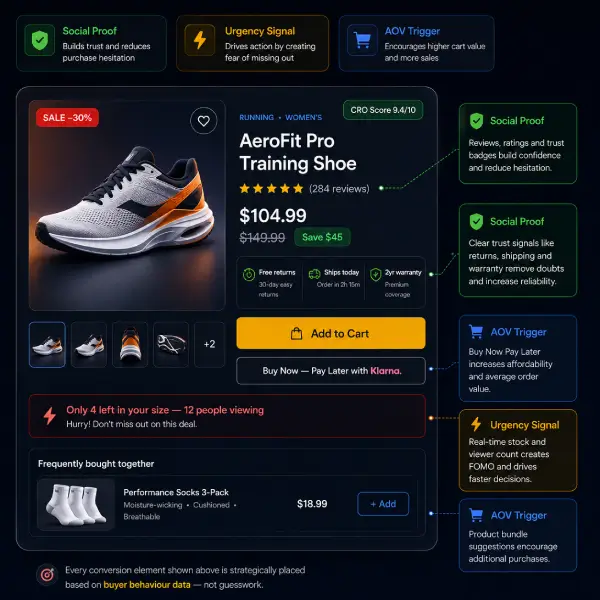
Most ecommerce development projects end at launch. Ours don’t. CRO is built into how we develop stores from the start — through the UX, the product page structure, the checkout flow, and the post-launch testing process. The goal is always the same: more revenue from the same traffic.

Product Page Optimisation Above-the-fold benefit copy, strategic review placement, urgency indicators, and clear size/variant guides that reduce hesitation and increase add-to-cart rates.

Checkout Optimisation Fewer steps, more payment options, trust badges at the payment stage, and order summary always visible — reducing the 70% industry-average cart abandonment rate.

Trust Signal Architecture Reviews, guarantee badges, security indicators, and social proof placed strategically at the moments in the buyer journey where trust matters most.

Upsell & Cross-Sell Systems Post-add-to-cart upsells, cart recommendations, and post-purchase one-click offers that increase average order value without adding friction to the primary purchase.

AOV Optimisation Bundle builders, volume discount displays, and free shipping thresholds configured to nudge buyers toward higher order values naturally within the shopping experience.
Ecommerce SEO

Built To Rank Beyond Paid Advertising

An ecommerce store that depends entirely on paid traffic to survive is a fragile business. When ad costs increase — and they always do — your margins compress and growth stalls. Organic search traffic is the antidote: it compounds over time, costs less per acquisition, and doesn’t stop when you pause your budget.
We build ecommerce SEO into the foundation of every store — because retrofitting it afterward never works as well as getting the architecture right from the start.

Category Page SEO Category pages optimised for high-volume commercial keywords — the pages that drive the most organic revenue in any ecommerce store.

Product Page SEO Unique meta titles and descriptions, structured data (Product schema with price, availability, and reviews), and content that ranks for long-tail product searches.

Technical SEO Foundation Canonical tags on filtered pages, crawl budget management, Core Web Vitals, XML sitemap, and structured URL hierarchies — all configured before launch.

Internal Linking Architecture Strategic internal links that distribute authority from your strongest pages to the category and product pages you want to rank — not random cross-links.

Content & Buying Guide Strategy Buyer-intent content — gift guides, comparison articles, how-to content — that captures research-phase traffic and funnels it toward purchase pages.

Structured Data & Rich Results Product schema, breadcrumb schema, and FAQ schema implemented across the store to earn rich results in Google — star ratings, pricing, and availability in the SERP.

Organic Ranking Results — Sample Store
#1yourstore.com › women › running-shoes
Women's Running Shoes | Free Returns | YourStore
Shop 200+ women's running shoes from top brands. Free next-day delivery, 30-day returns, price match guaranteed.
★ 4.8 (1,204)From $49.99In stock
#2yourstore.com › running-shoes › best-for-marathon
Best Marathon Running Shoes 2025 — Expert Guide
Our running experts tested 24 marathon shoes. Here's what actually works for long distances, broken down by foot type and budget.
#3yourstore.com › brands › nike › running
Nike Running Shoes — Women's Collection | YourStore
Browse the full Nike women's running range with exclusive colourways. Free returns on every order, same-day despatch before 3pm.
★ 4.7 (892)From $89.99
Organic Traffic Growth — Month by Month
M1
1,200
M2
2,100
M3
3,800
M4
5,600
M5
7,900
M6
11,400

Industries We Serve

Ecommerce Development For Every Product Category

We’ve developed specific playbooks for industries where the stakes are high and generic marketing advice falls flat.

Fashion

Lookbook integration, size guide tools, style filtering, and seasonal campaign architecture.

Beauty

Shade finders, ingredient transparency pages, subscription options, and UGC social proof integration.

Electronics

Deep spec comparisons, compatibility tools, warranty management, and B2B wholesale portals.

Home & Living

Room visualiser tools, material/finish variants, trade pricing portals, and interior content strategies.

Health & Wellness

Vehicle compatibility lookup, fitment filtering, B2B trade accounts, and parts catalogue architecture.

Automotive

Vehicle compatibility lookup, fitment filtering, B2B trade accounts, and parts catalogue architecture.

B2B Ecommerce

Tiered pricing, bulk ordering, PO workflows, account management, and ERP integration.

Luxury Products

Premium UX, white-glove service signals, high-resolution media, and concierge consultation booking.

FAQs

Questions We Hear From Every Ecommerce Brand

Real answers about our process, platforms, timelines, and what working with us actually looks like.
How much does ecommerce development cost?
Ecommerce development cost varies significantly based on platform, complexity, catalogue size, and required integrations. A straightforward Shopify store with a custom theme, standard integrations, and 50–200 products is a different scope from a custom-built multi-vendor marketplace or a headless ecommerce platform with ERP integration. What we can guarantee is that every quote is itemised and fixed — no hourly rates that escalate, no surprise invoices. After a free discovery call, we’ll give you a clear proposal with three things: what we’re building, how long it takes, and what it costs. The right conversation to have is: what does my business need to generate the revenue I’m targeting? We start there, then work backwards to scope.
This comes down to your business model, technical requirements, and how you want to manage the store long-term. Shopify is the right choice for most DTC brands — it’s hosted, maintained, and scales without server management. The trade-off is some flexibility and transaction fees if you use third-party gateways. WooCommerce is the right choice when you need deeper customisation, complex pricing rules, an integrated content strategy, or ownership of the complete codebase. It requires more technical management but gives you more control. There’s no universally correct answer — we’ll make a recommendation based on your specific situation after understanding your catalogue, integrations, content plans, and growth targets. Both platforms produce excellent results when built correctly.
A straightforward Shopify store with a custom theme and standard features typically takes 4 to 6 weeks from kickoff to launch. A more complex build — subscription functionality, marketplace features, custom integrations, large catalogues — typically takes 8 to 14 weeks. Custom-built ecommerce platforms are scoped individually. Timelines are affected by how quickly content, product photography, and approvals come through from your side — which is why our kickoff process includes a content checklist and a project timeline with clear milestones and dependencies. We’ve launched stores in as few as 3 weeks when the brief was tight and content was ready. We don’t artificially inflate timelines, and we don’t miss the ones we commit to.
Yes — every store we build includes a full technical SEO foundation at launch: URL structure designed for search engines, category and product page meta titles and descriptions, product schema markup (which enables star ratings in Google search results), XML sitemap, canonical tags on filtered and paginated pages, and Core Web Vitals optimisation. What this means is your store is crawlable, indexable, and technically sound from day one — so SEO activity you do afterward (content, link building, expanding category pages) has a solid technical foundation to build on. The SEO foundation is included in every development project. An ongoing SEO strategy is a separate engagement for clients who want to actively build organic rankings over time.
Yes — platform migrations are a significant part of what we do. Whether you’re moving from Magento to Shopify, WooCommerce to Shopify Plus, a custom platform to WooCommerce, or any other combination, we handle the migration carefully: product data, customer records, order history, URLs, redirects, and most importantly, your existing search engine rankings. A migration done without proper redirect mapping and SEO care can wipe out years of organic equity in days. We start every migration with an audit of your current rankings and traffic, then build a redirect strategy that protects what you’ve earned while improving the structure where it makes sense. We’ve migrated stores of every size without meaningful ranking loss.
Yes — and this is one of the highest-value things we do. Post-launch CRO starts with real data: heatmaps (where users click and scroll), session recordings (how buyers actually navigate your store), funnel analysis (where people exit before purchasing), and form analytics (where they drop off in checkout). From that data, we build a prioritised list of tests: A/B tests on product page elements, checkout flow experiments, CTA changes, social proof placement tests, and mobile UX improvements. Every change is measured before full rollout. The stores that consistently improve over time are the ones that invest in this process — because a 0.5% improvement in conversion rate on a store doing $100k/month is $500k/year in additional revenue from the same traffic.
Yes — we offer post-launch support and growth retainers. Support covers technical maintenance, security and platform updates, bug fixes, and minor feature additions. Growth retainers are for clients who want ongoing CRO, SEO, performance optimisation, and feature development — essentially, a continuous improvement programme rather than a one-time build. The right support level depends on your store’s complexity and how actively you want to develop it. We’ll recommend the right option at the end of the project, once we understand how the store is performing and what your priorities are. No pressure to commit to anything beyond the build before you’ve seen it live and understood what it needs.
Yes — payment gateway integration is a standard part of every ecommerce project. We configure Stripe, PayPal, Apple Pay, and Google Pay as standard. We also integrate BNPL (Buy Now Pay Later) providers including Klarna, Afterpay/Clearpay, and Affirm — which consistently improve average order value, particularly on higher-ticket products. For international stores, we configure local payment methods by region. The principle is simple: every payment option you don’t offer is a reason for a buyer to go elsewhere. We help you offer as many relevant options as possible with a checkout experience that doesn’t feel cluttered.
Yes — ecommerce SEO is one of our core ongoing service offerings. After building the technical foundation into your store, ongoing ecommerce SEO involves expanding category page content to target more commercial keywords, building product buying guides that attract research-phase traffic, earning backlinks to category and high-value product pages, optimising for new product launches, and managing technical SEO as the catalogue grows. Ecommerce SEO compounds over time: the stores that invest in it consistently over 12–24 months become significantly less dependent on paid advertising — because organic traffic is generating a growing proportion of revenue at a fraction of the acquisition cost. We’ll discuss the right level of ongoing SEO investment based on your category competition and growth targets.
Yes — and for most clients, this is where the biggest value comes from. A well-built store is a starting point, not a destination. Post-launch, we offer CRO programmes (ongoing A/B testing and conversion improvement), ecommerce SEO (organic traffic and ranking growth), performance marketing (Google Shopping, Meta Ads, and paid social), email and retention marketing, and AI automation (abandoned cart recovery, customer segmentation, personalised recommendations). The brands that grow fastest are the ones that treat the store launch as the beginning of a continuous growth programme — not a project that’s finished when the site goes live. We’re set up to be a long-term growth partner, not just a development agency you engage once.

Get Started

Ready To Build An Ecommerce Store That Generates More Revenue?

A beautiful store that doesn’t convert is just an expensive catalogue. Successful ecommerce growth requires the right platform, conversion-optimised UX, a technical SEO foundation, and a team that measures success in revenue — not deliverables. That’s what we build.
⚡Free 30-min strategy session
📱Shopify & WooCommerce experts
🔍Revenue-focused from day one
⚡Response within 24 hours